1000help


Help page
What is a Chinese character?
a b c d e f g h i j k l m n o p q r s t u v w x y z , these are the English characters, the alphabet, 26 letters. Do you remember how long it took to learn them at your first class school?
My dear English speaking friend, you are lucky, very very lucky.
The majority of Chinese speaking people in their 80's still don't know all Chinese characters!
What about your computer or the electronic device you use to read this page? Can they display Chinese characters? Let's check.
If they can, you should be able to read the following Chinese text meaning "Hello!":
你好!
If you see only boxes or question marks, please read the help files of your operating system and of your browser to find out how to install or download the component for simplified Chinese.
If you have any problem, please send me a message including names and versions of your operating system, of your browser, and of your email reader. I'd try to help.
Chinese language counts more than 50,000 (yes, fifty thousands, five hundred hundred) different characters!
Infact Chinese language does not have an alphabet. While in English any word is represented by a sequence of a different number of alphabetic characters (for example the word "hello" is composed of 5 characters, the word "a" by 1 character, the word "Llanfairpwllgwyngyllgogerychwyrndrobwllllantysiliogogogoch" by 58 characters), in Chinese any word is represented by its own character (better said, often by the composition of two characters, or, less frequently, of three, four, five characters).
For example the word 'computer' is composed of two characters, as you can see below.
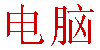
(for rules about pronunciation, I'll tell you later)
Interestingly, the first character  )
) )
)
Real Chinese names
versus
Your Chinese name
All Chinese people's names have a profound meaning. From childhood, the little Chinese baby is associated with strengh, beauty, intelligence, ability, etc.
Then it may happen that a couple of Chinese mates call their three daughters nice smile, wonderful smile and bright smile, or their son powerful and intelligent.
Western names "translated" with Chinese characters take the meaning of each used character, with usually a lot of different meanings.
How to write Chinese characters
"How do I write Chinese characters?" might seem a simple question to answer.
Beginning with the simplest thing, we can say that modern Chinese language is written horizontally from left to right, from the top line of the page to the bottom, just as English.
o  w  c  n  t  t  t  w  t  p  e  a  p  E
n  r  o  e  h  h  o  r  h  e  x  s  l  X
   i  m  w  e  e  p  i  e  o  a     a  C
t  t  b  s           t     p  m  H  c  E
h  i  i  p  l  r  t  i  t  l  p  o  e  P
e  n  n  a  e  i  o  n  r  e  l  n  s  T
   g  e  p  f  g     g  a     e  g     I
s        e  t  h  b     d  h  ,     o  O
a  d  d  r  .  t  o  v  i  a     K  f  N
m  i  i  s        t  e  t  v  C  o     :
e  r  f     C  c  t  r  i  e  h  n  t
   e  f  s  h  o  o  t  o     i  g  h  I
p  c  e  o  i  l  m  i  n  r  n     e  n
a  t  r  m  n  u  ,  c     e  e  f
g  i  e  e  e  m     a  o  t  s  o  w  s
e  o  n  t  s  n  f  l  f  a  e  r  o  o
.  n  t  i  e     r  l     i        r  m
   s     m     t  o  y     n        l  e
         e     o  m        e        d
         s                 d        ,
Warning: Writing from top to bottom, never rotate the characters!
Anyway, what makes things really different is the way every single Chinese character has to be written.
Any Chinese character is composed of strokes, in different number.
What are strokes?
Every Chinese character is composed of strokes.
A stroke is a single movement of the pen. A Chinese character might be composed of only one or even by more than thirty strokes.
To help you become familiar with strokes, on lesson 1 (click here for the lesson) of the mini course about Chinese characters' strokes, you can find a table with the shape of all simple strokes and read their name and writing direction. In addition you'll even find some example characters containing the given stroke.
Besides, lesson 2 (click here for the lesson) of the same mini course contains a table with shape, name, writing direction and example characters of all complex strokes.
Strokes order rules
Rule #1: Writing each stroke (simple or complex), from its beginning to its end, you need not lift your pen from the paper—and do press it as much as possible!
Rule #2: It's about direction of writing each stroke: it must be respected.
Rule #3: Strokes cannot be written in any order one wishes. A definite strokes order must be followed.
WHY rule #1, rule #2 and rule #3?
(I know, the result would be exactly the same!):
Short answer: BECAUSE IT'S CHINESE!
Long answer: Usually dictionaries list characters alphabetically according to their pronunciation (pin yin). But what if you need to find a character whose pronunciation you don't know?
Dictionaries have lists of characters grouped by number and/or sequence of strokes, so that you'll find, for example, a list of characters all composed of ten strokes and all starting with a vertical stroke, or a list of ten strokes characters starting with a dot, and so on. That's why it's imperative to standardize strokes and strokes order.
One more reason: How would a Chinese girl feel watching you writing a Chinese character ignoring any rule about direction or strokes order? She would feel exactly as you watching someone writing "Frank" this way:

Did you get the point?
In my website, I chose to animate all Chinese characters because that way makes very easy to learn the order of strokes.
Furthermore, in the table contained in lesson 3 (click here for the lesson) of the mini course about Chinese characters' strokes, I've also used animations to illustrate a few basic rules about the right sequence to follow writing Chinese characters.
Chinese characters pronunciation
Some characters have more than one pronunciation. Interestingly, only the shape of a character is unique, not its pronunciation. I mean that different characters do sound exactly the same way.
For example, the following ninety characters have all the same pronunciation, that is yi4 (for rules about pronunciation, I'll tell you later).
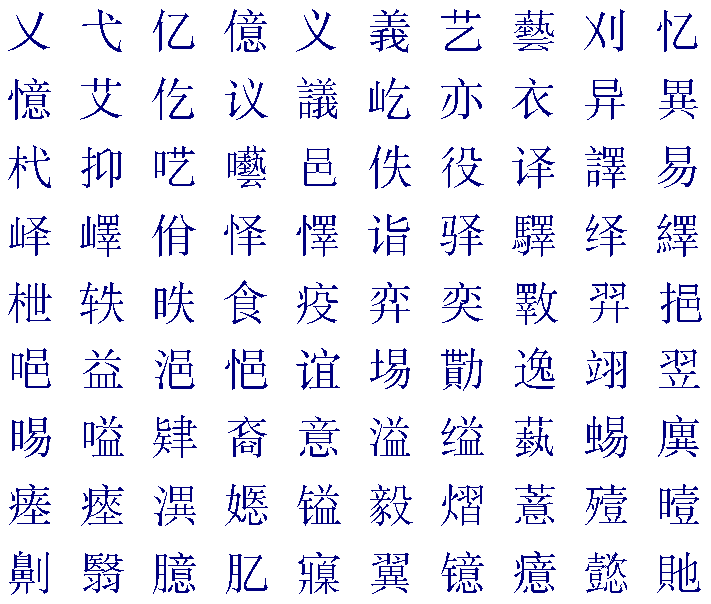
Listen to its pronunciation: yi4
The pronunciation of any character is always a monosyllabic sound and, for the jubilation of those familiar with a, b and c, Chinese dictionaries use latin characters to indicate it. Some examples: ba, mu, shu, xiao.
What are tones?
Each of those 'syllables' can be pronounced in five different ways, depending on the intonation given to it.
This is called the character's tone.
Chinese language has 4 different tones + 1 neutral tone.
Four different stress marks indicate the character's tone (there's no stress mark for the neutral tone).
The phonetic system so described (latin characters to indicate the pronunciation plus a stress mark to indicate the tone) is called pin yin.
In the table below, 5 pin yin examples indicate how the syllable "ma" is pronounced in the four tones + the neutral one. Click on them and you will listen to their pronunciation.
For simplicity, the pin yin of any Chinese character is given without stress marks. A number after each syllable indicates the tone (1 for the first tone, 2 for the second an so on, so that "ma3" would mean "ma" in the third tone or "xian5" would mean "xian" in the neutral tone).
Taking again "ma" as example:
- ma1: sound "ma" in the first tone;
- ma2: sound "ma" in the second tone;
- ma3: sound "ma" in the third tone;
- ma4: sound "ma" in the fourth tone;
- ma5: sound "ma" in the neutral tone;
It's absolutely vital to pay attention to the intonation, because the meaning of what you say depends on it.
The sound "ma", if pronounced in the first tone would mean 'wipe' (and also 'mum', because the same pronunciation is common to more than one character), in the second tone would mean 'numb', in the third 'horse', in the fourth 'curse', in the neutral tone it's used at the end of a sentence to ask questions.
To illustrate, we can draw a vertical line to represent the range of the variation of one's pitch. From the low end upward, five points (1, 2, 3, 4, and 5) represent the low, middle-low, middle, middle-high and high pitch respectively.

In the chart, the first tone is represented by the red line (55, that is from level 5 to level 5);
the second tone by the cyan line (35);
the third tone by the magenta line (214);
the fourth tone by the green line (51).
The neutral tone is not represented because the pronunciation must be short and weak.
Now, please pause a little on improving your pronunciation, listening to the following supplementary examples of characters in the four+neutral tones.
I know, the concept of tones is completely foreign to English speaking people. So try your best to repeat the following sounds in the four+neutral different tones—you are mastering one of the most difficult aspects of Chinese language! With little exercise you'll be able to pronounce any Chinese character exactly as if you were Chinese yourself!
When I say Chinese pronunciation of a character, I refer to its Mandarin Chinese pronunciation.
Mandarin Chinese is the main dialect spoken in China, originally spoken in the area around Beijing but since 1955 adopted as official language of the People's Republic of China.
In China are spoken a lot of different dialects. Among them there are Cantonese (spoken for example in Hong Kong) and Taiwanese.
Here at WearYourChineseName™ we strictly adhere to the official, standard Beijing pronunciation.
Interestingly, the writing system (Chinese characters) is the same for all China, no matter which dialect is spoken; so the term Mandarin (or Cantonese) refers only to the spoken language.
Meanings: why so many?
Almost every Chinese character, if taken alone, has more than one meaning. Words often are composed of two or more characters. When a single character is used alone, its meaning depends on the context.
Translation hint: If you don't know how and when any word is used in Chinese language, don't use the content of this web site, even the content of a dictionary, to compose Chinese sentences word by word from English sentences. The any way perfect translation of a single word might in many cases be misleading. As all expert translators well know, words are used differently in different languages.
Traditional or simplified Chinese?
We've seen that the reference to Mandarin Chinese relates to spoken language.
Now the distinction between traditional and simplified Chinese refers to the written Chinese.
In 1964 the People's Republic of China made a sort of lifting to around 2300 characters, giving them a new face. The old version of those characters is called traditional Chinese, the new version is the simplified Chinese.
However, the simplified system has not been adopted outside the Chinese mainland. People in Hong Kong, Macao, Taiwan and other overseas regions are still using traditional characters.
That's why we have now two different versions of many Chinese characters: the traditional and the simplified one. Same meaning, same pronunciation, same usage, two different characters.
In a few cases, more traditional characters have been simplified in just one, so their meanings match only partially.
Do you want to see an example of a character's old version and its new face after the lifting? Pronunciation and meaning have remained the same:


| - | Practise; exercise; review |
| - | Get accustomed to; be used to; become familiar with |
| - | Habit; custom; usual practice |
| - | A surname |
I wish you like my website and go on clicking and clicking on its other sections!